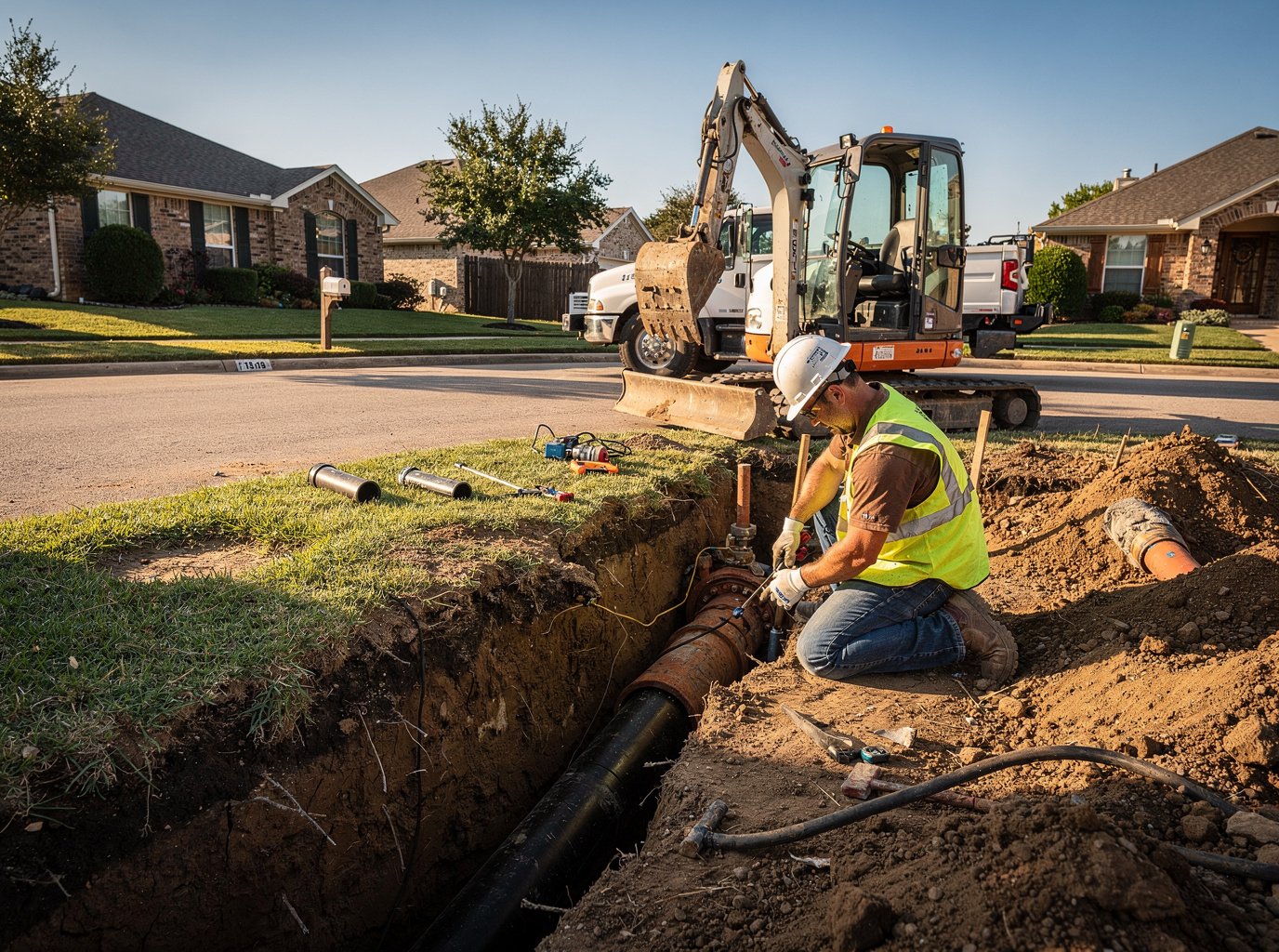
Our Slab Leak Repair Dallas service addresses water leaking from a pressurized supply line that runs beneath a concrete slab foundation. Most Dallas homes built on slabs carry their hot and cold supply lines through or under the concrete, so when one of those lines fails, the water often has nowhere to show itself except the soil under the house, the flooring above, or the water bill. We work on these leaks every week across Dallas, from older homes near Lake Highlands to newer subdivisions in the north and east parts of the city.
Dallas sits on expansive clay soil, and that matters for slabs. When the ground dries out during a long summer, the clay shrinks and pulls away from the foundation. When heavy rain follows, it swells again and pushes back. That movement stresses copper and galvanized lines where they pass through the slab, and it often cracks a fitting or pinches a line at a bend. A slab that has shifted a little can also crack a line that was fine for decades. Those are the leaks we see most often, and they tend to show up in hot, dry stretches followed by a hard storm.
You need slab leak repair when the leak is inside the concrete or directly beneath it and the water pressure in the line is what is feeding it. Ignoring it does not make it stop. Water keeps undermining the soil around the foundation, and the damage moves from a wet spot in the carpet to cracked tile, warped subfloor, and in some cases foundation movement that is harder and more expensive to correct than the pipe itself.
Signs a Dallas Slab Leak Is Developing
The clearest sign is a water bill that climbs without any change in how the house is used. Other signs include a warm spot on the floor in a room where the hot water line runs under the slab, damp or soft carpet that never fully dries, a hissing or running sound when every fixture is shut off, a crack in the wall or floor tile that appears or widens after a dry spell, and water pressure that drops at one fixture while the rest of the house is normal. Some homeowners notice a patch of unusually green grass or soft soil near the foundation, especially on the side where the water line enters the house.
Do not wait for all of these. Any one of them, particularly a rising bill with no other explanation, is enough reason to have the system checked.
How We Inspect and Locate the Leak
Finding a slab leak is the hardest part of the job, and it is where a lot of guesswork happens elsewhere. We start by confirming that the water is leaking from the pressurized supply and not from a drain, a toilet flapper, or an irrigation line. We shut off the fixtures and watch the water meter at the street to see whether it is still moving. If it is, we know the leak is in the supply side of the system.
Next we run a pressure test on the supply lines to see how fast the system loses pressure and to help us narrow the area. We listen at the wall, floor, and cleanout points with listening equipment, because a pressurized leak often makes a faint hiss or rush that carries through concrete. We then trace the line path using the building plan and our tracing equipment, so we can mark where the pipe runs under the slab before we open anything. Only when the leak is narrowed to a specific section do we make an access point, usually at the smallest opening that will reach the failure.
What the Repair Involves
Once we know where the leak is, we decide between a spot repair and a reroute. A spot repair means cutting out the failed section, replacing it with new pipe and fittings, and sealing the connections. A reroute means running new supply line above the slab, through the attic or wall where accessible, and capping the old line so it no longer carries pressure. We recommend a reroute when the line is old, corroded throughout, or runs under a lot of slab that would have to be opened. We will walk through the reasons with you before any work starts so you know what is being done and why.
We protect the flooring and the surrounding area during the repair, and we keep the disturbed concrete to the smallest footprint we can. Where we need to break concrete, we take care to leave the surrounding slab sound.
Technician insight
In Dallas, the thing that catches most people out with a slab leak is assuming the water bill is the first sign. By the time the bill jumps, the leak has often been working on the soil under the foundation for weeks. After a dry summer and a hard rain, the clay moves, and a line that held for years can split at a fitting. If the floor is warm in one room or the meter keeps turning with every fixture off, call us then, not after the carpet starts to lift.
Warm Floor and a Climbing Meter in a Northeast Dallas Slab Home
The homeowner noticed a warm patch in one bedroom and a water bill that had climbed with no change in use. We found the meter still moving with every fixture off and a pressure drop that pointed to the supply side under the slab. Listening and line tracing narrowed the leak to a corroded section of copper near a bend in the hot water run, and we opened a small access point to reach it. We replaced the failed section, pressure tested the repair, and confirmed the meter held still before closing the opening.
Sewer Line Repair Services We Offer
✓Leak Isolation Valves
Isolation valves let us shut off a single section of the supply system without cutting off water to the whole house. We install them where a slab line branches or where a future repair may be needed, and we test each one under pressure to confirm it closes fully and holds.
✓Rerouted Supply Lines
When a slab run is too old or too damaged to repair in place, we run new supply line above the slab through accessible wall cavities, attic space, or a crawlspace. We pressure test the new route and verify every connection before we retire the old line.
✓Fixture Shutoffs
Fixture shutoffs sit at sinks, toilets, and water heaters so that each fixture can be isolated for service. We replace worn or seized shutoffs during slab work so they can be closed reliably later, and we check that they hold without dripping at the stem.
✓Pipe Connections and Transition Fittings
Where new pipe meets existing copper, galvanized, or PEX, we use transition fittings and proper joints to make a secure connection. We check each joint for seepage while the system is pressurized and recheck it after the water is restored.
✓Pressure Testing of Repaired Sections
We pressure test each repaired or rerouted section before we backfill or close any access point. This confirms the work holds under normal operating pressure and gives us a clear reading to compare against the original leak rate.
✓Access Point Restoration
After the repair, we restore the access point in the wall, floor, or cleanout so it is easy to reach and seal properly. We leave clear access for future service so the line can be inspected without another large opening.
How it works
- 1
Confirm the Leak Is in the Supply Line
We shut off the fixtures and watch the water meter to confirm the water is leaking from the pressurized supply. This rules out drains, toilets, and irrigation before we open anything.
- 2
Test Pressure and Narrow the Area
We run a pressure test on the supply lines to measure how quickly the system loses pressure. The result tells us whether we are dealing with a small seep or a larger failure.
- 3
Listen and Trace the Line
We use listening equipment at walls, floors, and cleanouts to pick up the sound of escaping water through concrete. We then trace the pipe path against the building plan so we know where the line runs under the slab.
- 4
Open the Smallest Access Point Needed
We make the smallest opening that reaches the failure. We protect flooring and the surrounding area and keep the disturbed concrete to a minimum.
- 5
Repair or Reroute the Line
We cut out the failed section and replace it with new pipe and fittings, or we run a new supply route above the slab and cap the old line. We choose the method based on the age and condition of the run and explain the choice before work begins.
- 6
Pressure Test Before Closing
We restore pressure in stages and watch each connection for seepage. We pressure test the repaired section to confirm it holds before we backfill or close the access point.
Pricing
Every sewer job starts with a clear scope of what we found, what we propose, and what the work involves, so you know the plan before work starts.